Structured Visual Knowledge Graph Extraction for Design Generation
TL;DR
Designers describe goals with ambiguous adjectives (“modern”, “minimal”), but a generative model must pick one interpretation among many — and it silently reinterprets from turn to turn, so intent drifts. GenAlign externalizes each abstract attribute as inspectable segment–property bindings in a personal Visual Knowledge Graph (VKG) that updates in real time. The bindings act as stable anchors, so body→geometry→angular means the same thing in turn 1 and turn 10 — turning guess-and-check prompting into systematic, personalized property editing.

Abstract
Designers often describe goals using ambiguous adjectives (e.g., modern); however, generative AI systems struggle to navigate this ambiguity, creating misalignment between language, intent, and outcomes. When the intended meaning remains implicit and unstructured, design generation cannot be guided precisely, resulting in semantic drift. Rather than logging past user operations, we present GenAlign, a graph-backed, human-in-the-loop design support system that externalizes cognitive visual attributes as segment–property bindings in a visual knowledge graph (VKG). GenAlign externalizes abstract attributes as segment-property bindings and maintains them as inspectable, reusable, and personalized bindings through real-time VKG updates. In a within-subject study with 24 professional designers, GenAlign transformed abstract attributes into reusable property vocabularies, supported personalized design strategies, and reduced per-step semantic drift across iterations. We discuss how VKG functions as an operational boundary object, that bridges interpretive and executable design representations rather than eliminates ambiguity.
Overview
From part-level segmentation to property-based generation, each stage sharpens the system’s semantic grasp of a design.
Multi-granularity part-level segmentation using Semantic-SAM with Swin-L Transformer, extracting precise object boundaries and hierarchical part structures.
GPT-4o Vision-powered extraction of visual attributes — material, color, style, and relationships — transforming visual features into structured semantic properties.
Structured triple extraction following VisualSem ontology with 13 standard relations plus a custom “is-style-of” relation, building a cognitive graph of design elements.
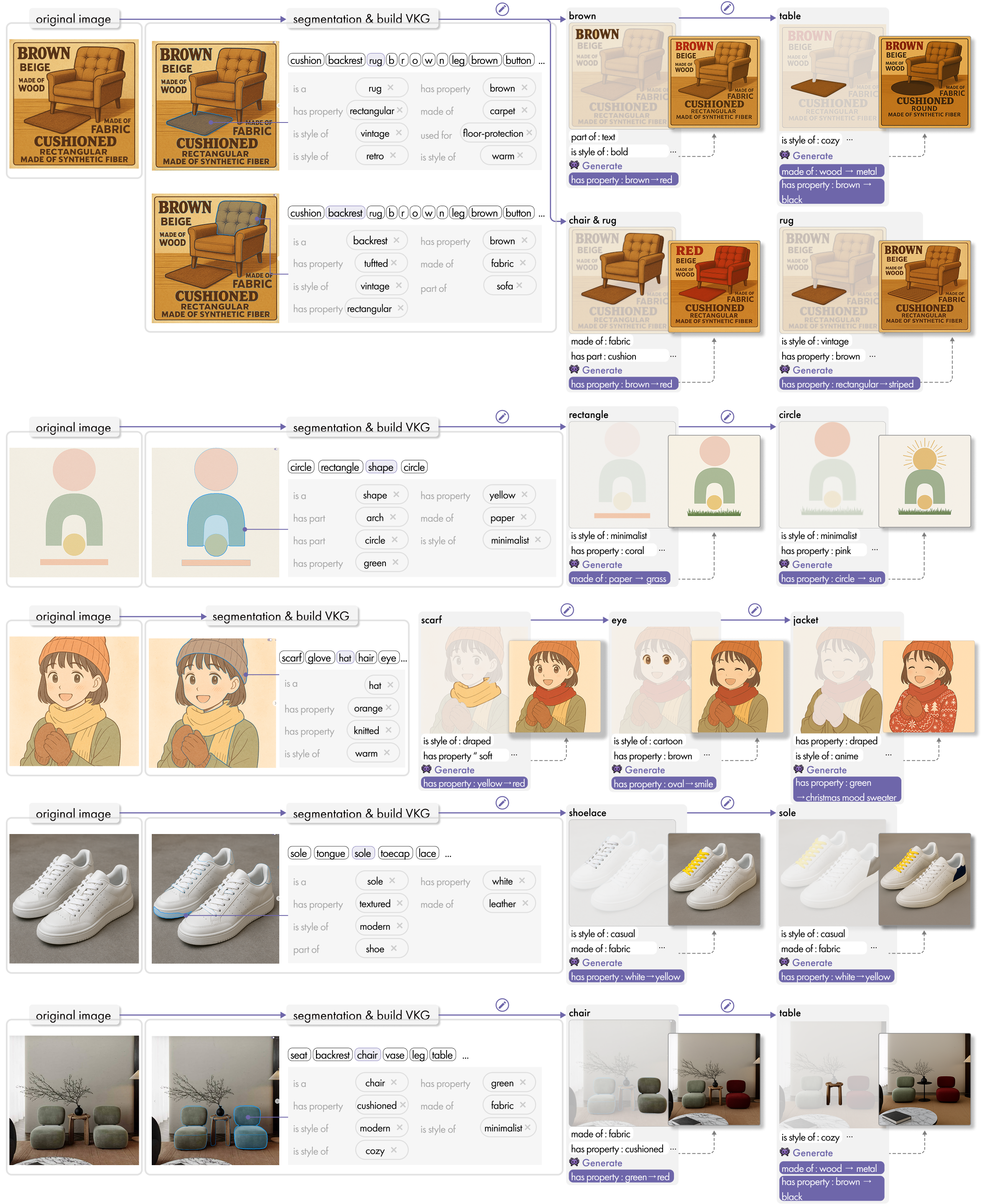
Generate and edit designs by transferring or modifying properties in the knowledge graph — enabling precise control over material, style, and form.
System architecture
The interface
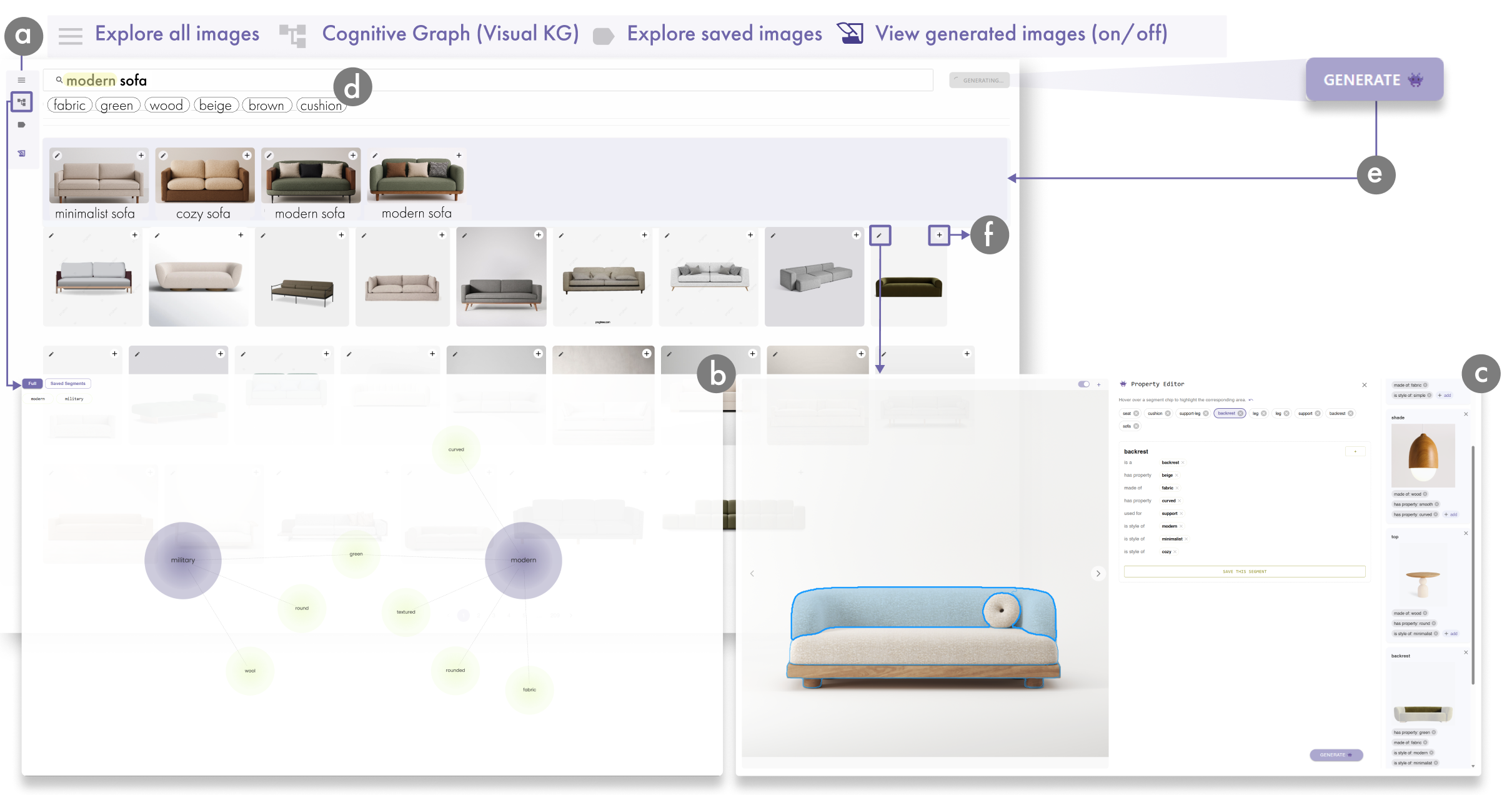
The extracted graph puts style concepts (large nodes) and the concrete properties (small nodes) that realize them in one view. Hover a style node to light up the properties bound to it.
minimal
playful
fabric
green
round
yellow
glossy
Hover minimal or playful → the properties bound to that style — and the images realizing them — light up, while the rest fade.
Click a segment on the sofa (or a tab) — it highlights and its typed properties (is-a, made-of, is-style-of…) appear. Click a property to select it.
The pipeline
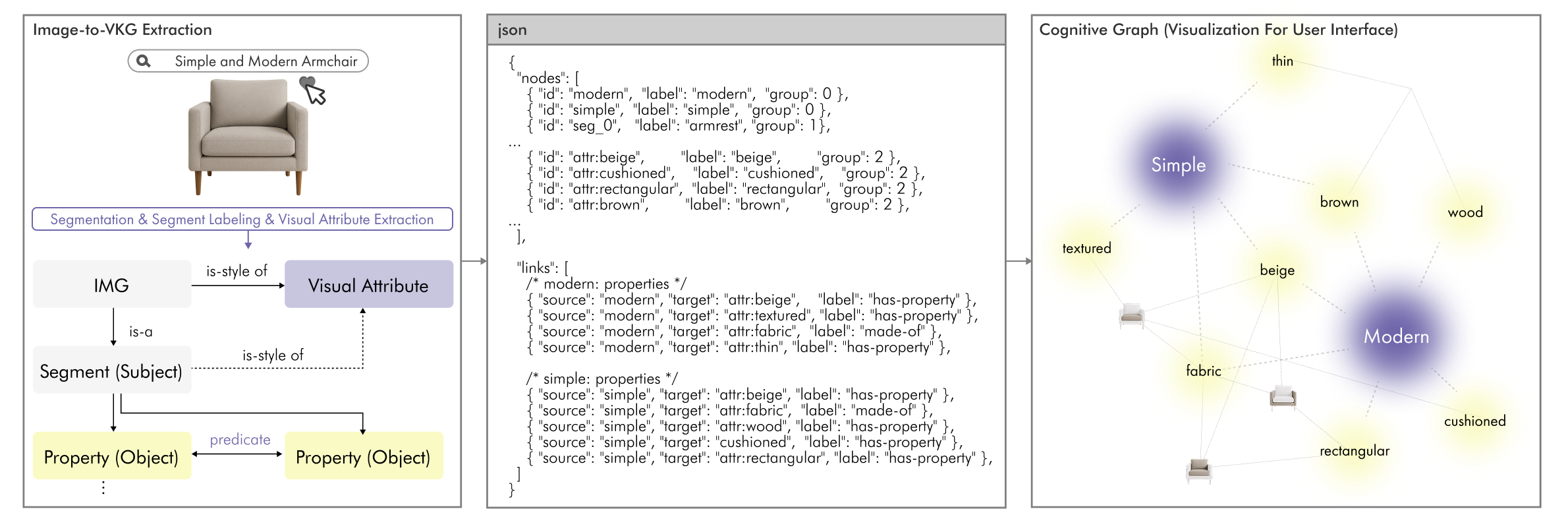
Each stage refines the semantic representation — segmentation, labeling, attribute extraction, triple construction, and post-processing.
Multi-granularity part extraction using Semantic-SAM, producing hierarchical masks with object/part labels (e.g., sofa-armrest, table-leg).
GPT-4o Vision analyzes each segment to assign semantic labels, understanding both the part identity and its role within the overall object.
Extract fine-grained properties including material (wood, metal, fabric), color, texture, shape characteristics, and functional attributes.
Build structured knowledge graph triples following VisualSem ontology: is-a, part-of, made-of, has-property, is-style-of, and more.
Normalize properties, inject into the cognitive graph, and save VKG logs for analysis and generation tasks.
The full extraction process — from segmented parts to a densified graph of typed relations.
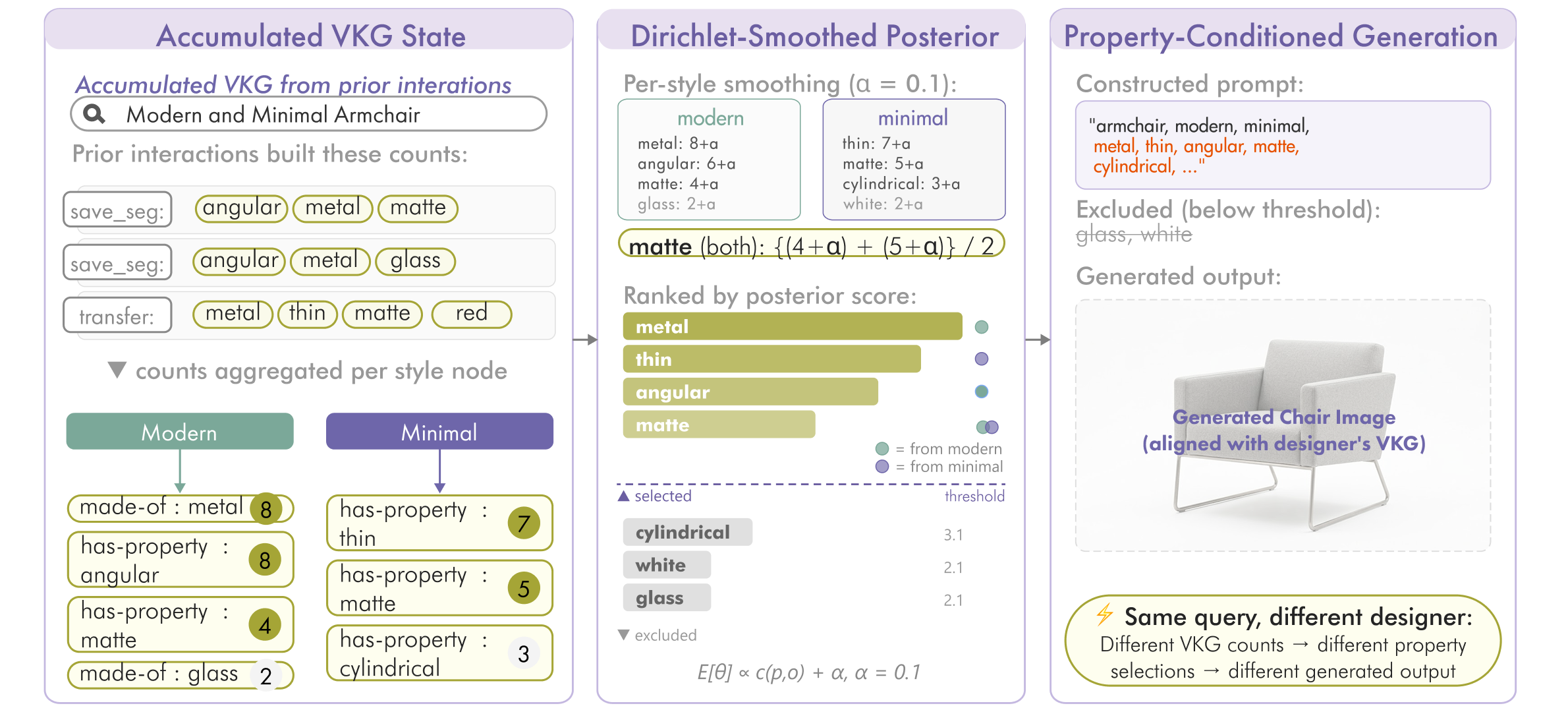
Property-grounded generation and editing, driven by the accumulated knowledge graph — only the most relevant bindings are injected into the generator.
Results
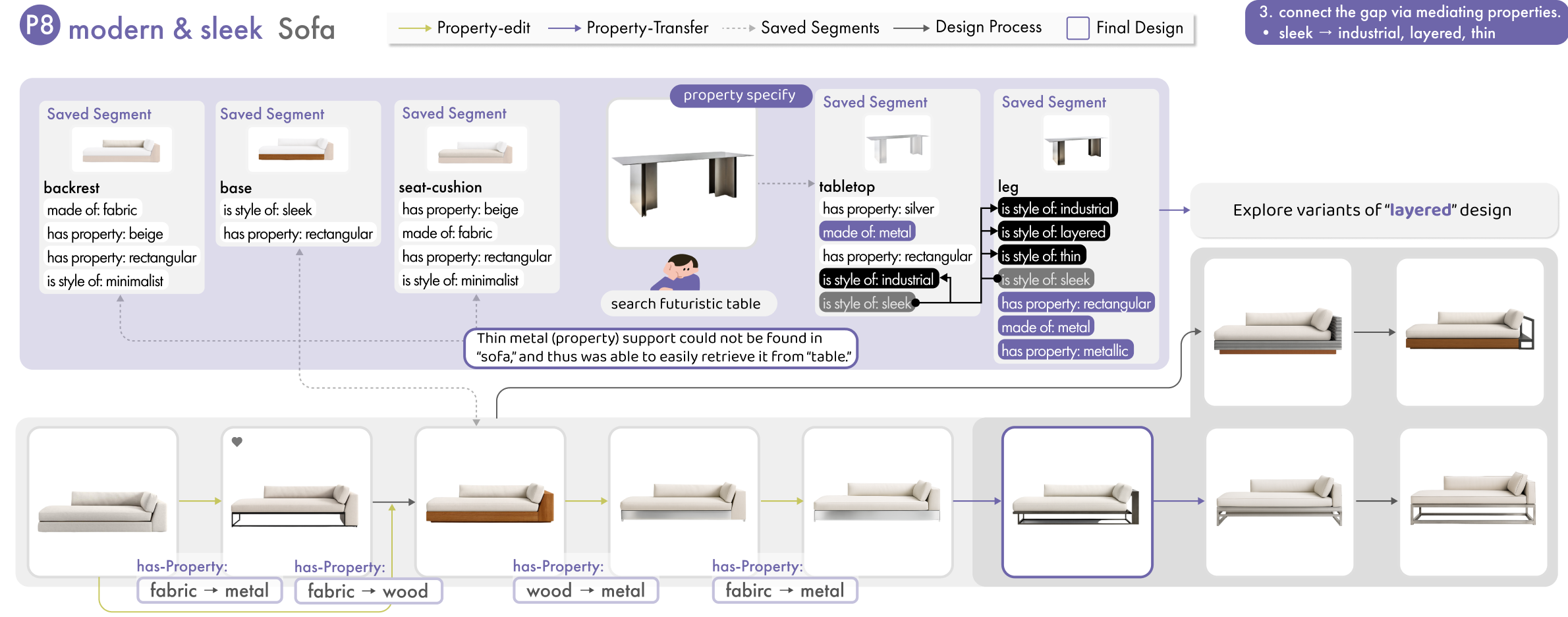
Designs produced by transferring and modifying graph properties — furniture, posters, characters, footwear, and interiors.
The History-Based Injection (HBI) selection feeds the generator only the designer’s most relevant bindings. It reaches comparable CLIP similarity to injecting the whole graph while using 7.2× fewer properties — an 85.9% reduction (96.7 → 13.4 properties per generation).
User study
Designers (M = 5.4 yrs experience) completed furniture & product tasks defined by conflicting attribute pairs — minimal × playful, modern × sleek — comparing GenAlign against a Baseline without VKG editing, in counterbalanced order.
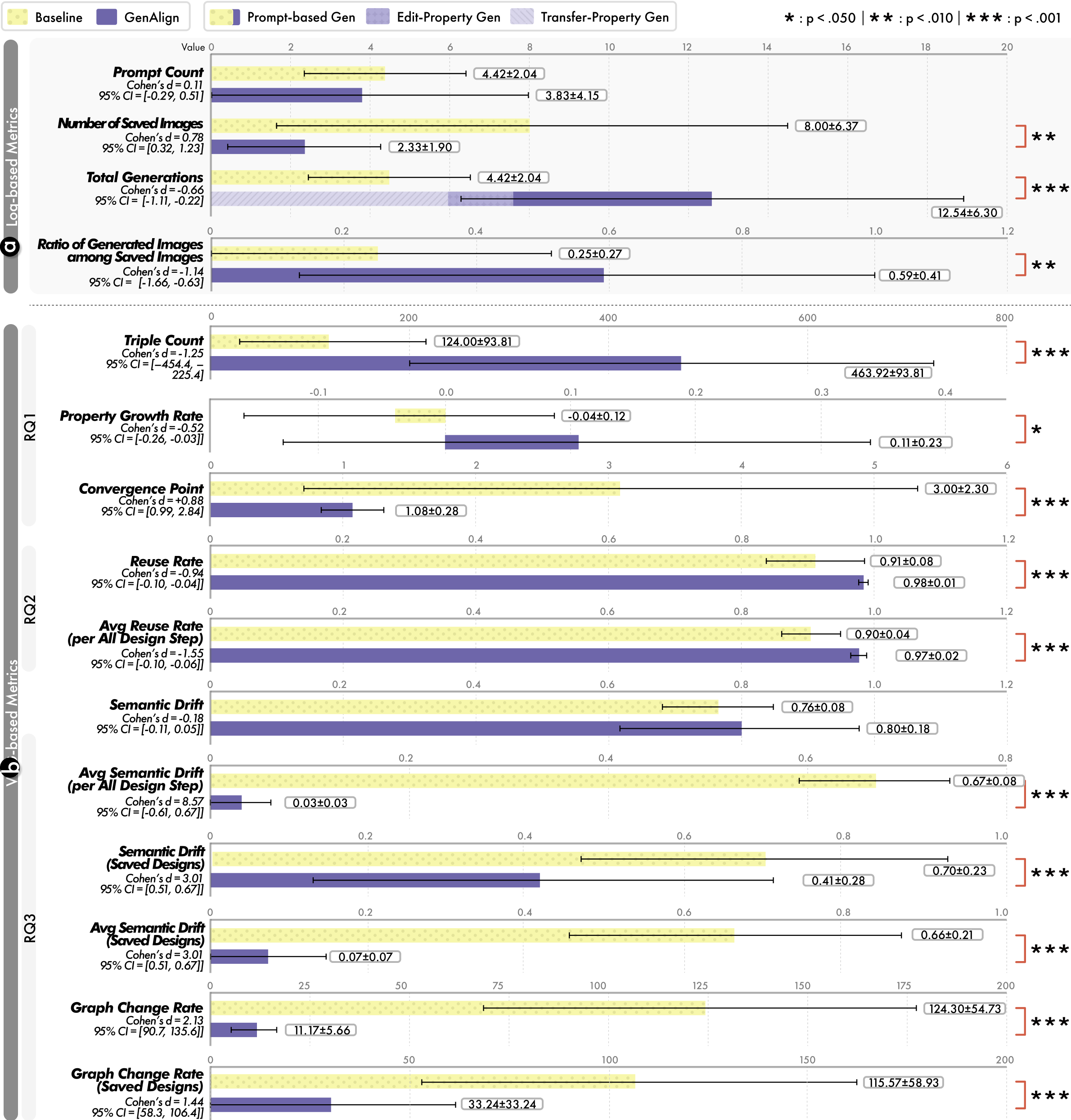
Decomposing abstract adjectives into segment–property bindings shifted interaction from guess-and-check prompting to systematic property editing. Perceived effectiveness rose sharply (3.54 → 6.29, p<.001).
A user-evolving VKG captured each designer’s own meaning of an attribute. Total generations rose 2.84× while saved images dropped 3.43× — a 0.98 reuse rate shows a growing personal vocabulary, not stockpiled examples.
Explicit bindings act as stable anchors, so intent doesn’t drift turn to turn. Per-step semantic drift fell 22× (0.67 → 0.03) and graph rewiring 11× — yet overall diversity increased.
Post-task ratings (7-point scale; CSI on a 10-point scale) across all 24 participants. GenAlign leads on every quality item, with lower frustration.
| Item | Baseline | GenAlign | p |
|---|---|---|---|
| Freely express design intentions (Q1) | 3.33 | 6.31 | <.001 |
| System understood my intentions (Q3) | 3.42 | 6.15 | <.001 |
| Performance (NASA-TLX, Q8) | 3.54 | 6.00 | <.001 |
| Frustration (NASA-TLX, Q10) · lower is better | 3.38 | 1.44 | .003 |
| Satisfied with results (Q11) | 3.88 | 6.42 | <.001 |
| Results are diverse (Q13) | 4.50 | 6.44 | <.001 |
| Results are creative (Q14) | 3.38 | 6.29 | <.001 |
| Understood attributes & connections (Q18) | 2.71 | 6.46 | <.001 |
| Enjoyment (CSI, Q23) · /10 | 5.56 | 9.39 | <.001 |
Values are means (n = 24). Significance after Holm–Bonferroni correction; Wilcoxon signed-rank except where a paired t-test applied. The largest gap is on understanding attributes and their connections (+3.75) — the structure itself, not just the outputs.
Semi-structured interviews surfaced why the numbers moved — the relief of editing one wrong property instead of re-prompting, and seeing the system’s interpretation made visible.
“In Baseline, I kept rephrasing prompts hoping the AI would guess my intent. With GenAlign, I could just adjust the specific property that was wrong.”
“Baseline gave me random surprises — sometimes good, often frustrating. GenAlign gave me intentional variations — I knew why each output was different.”
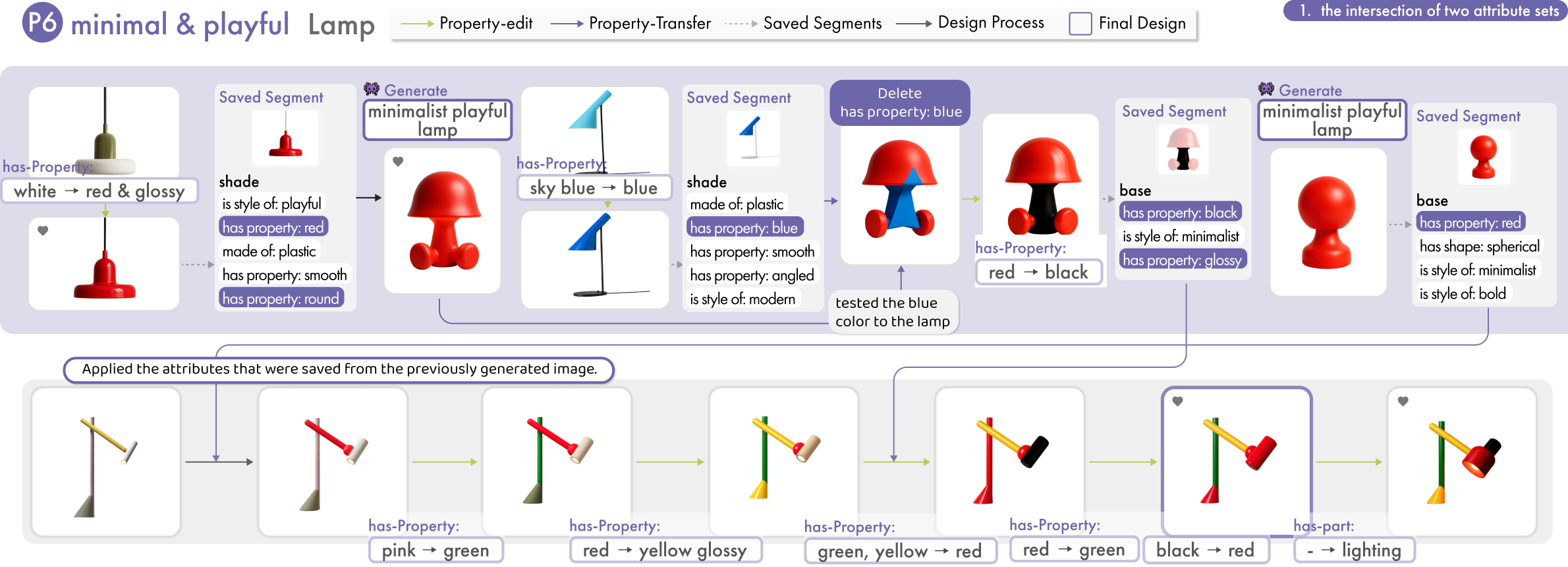
Designing a “minimal × playful” lamp, P6 discovered role-splitting — minimal as geometry, playful as color — not by prompting, but by inspecting saved segment properties.
The takeaway isn’t that GenAlign generates better images — CLIP similarity is comparable to injecting the whole graph. It’s that GenAlign makes intent explicit, traceable, and stable. By externalizing abstract adjectives as inspectable segment–property bindings, it lets designers build a reusable design vocabulary and explore along dimensions they chose — turning random variation into controlled, personalized exploration.
Video